Understanding Epilepsy: A Honest Guide
If you are reading this guide on Epilepsy, I know exactly why you are here. Perhaps someone you love just had a seizure. Alternatively, a doctor might have just said the word, and now your world feels like it is spinning.
I am Dr. Saqlain Mushtaq. Before I am a doctor, I am a human being. I have sat across from hundreds of people with the exact same look of fear in their eyes that you have right now. Therefore, take a deep breath. We are going to walk through this together, step by step.
What Epilepsy Really Is
First, let’s clear the air. There is so much stigma attached to this word, and it breaks my heart. Many people wrongly assume it means you are physically fragile. That is simply not true.
To understand Epilepsy, think of the brain as a massive, sophisticated symphony orchestra. You have violins (memory), drums (movement), and flutes (speech). Usually, the conductor waves the baton, and everyone plays in perfect rhythm.
However, a seizure is simply a moment where one section of the orchestra—say, the trumpet section—decides to play as loud as they can. They do this all at once, without the conductor’s permission. Consequently, the rest of the orchestra gets confused and stops playing because the noise is too loud. That is a seizure. It is an electrical improvisational solo that was not on the sheet music.
For example, let me tell you about Liam. He is a 28-year-old graphic designer I treated recently. Liam is sharp, funny, and incredibly talented. He came to me terrified because he kept “losing time.” He wasn’t shaking on the floor; instead, he would stare at his computer screen. Suddenly, ten minutes had passed. He felt completely confused.
It turned out to be focal epilepsy. Once we figured that out, the relief on his face was palpable. He wasn’t losing his mind; his “orchestra” just had a few over-enthusiastic trumpet players.
Recognizing Epilepsy Symptoms
Because of Liam’s story, you likely realize that seizures aren’t always dramatic falls. In fact, movies often portray this incorrectly. While convulsions happen, the signs can be much subtler.
If you are watching a loved one for signs of Epilepsy, keep an eye out for these indicators:
- The “Stare”: A blank look where the person is unresponsive for a few seconds.
- Repetitive Movements: Chewing, lip-smacking, or fumbling with buttons on a shirt.
- Sudden Confusion: Waking up or “snapping back” without knowing where they are.
- The “Aura”: Many patients describe a weird smell (like burning rubber) or a sudden wave of fear.
- Unexplained Falls: Sudden loss of muscle tone causing them to drop things.
My first thought when a patient describes “zoning out” is never just stress. Instead, I always want to rule out absence seizures first because they are so often missed.
Root Causes: The Honest Truth
We doctors sometimes like to pretend we have all the answers. But I promised to be real with you. To be perfectly honest, the medical community is still exploring the precise mechanism for nearly half of all Epilepsy cases.
We call this “idiopathic,” which is a fancy medical word for “we simply don’t know yet.”
However, for the other half, we can pinpoint the cause. As the WHO data shows, these causes often include:
- Head Trauma: A severe car accident or sports injury.
- Brain Conditions: Things like tumors or strokes (especially in older adults).
- Infectious Diseases: Meningitis or viral encephalitis can leave scarring.
- Genetics: Sometimes, the sheet music is just written that way from birth.
But here is the most important part: It is not your fault. You didn’t cause this by eating the wrong food or being too stressed.
The Diagnostic Journey
If you suspect Epilepsy, the waiting game is the hardest part. I want to prepare you for what happens when you walk into a clinic like ours or others I mentioned in recent posts.
I recall Sarah, a 52-year-old librarian who was absolutely petrified of hospitals. She sat on my exam table gripping her purse tightly. She was afraid we would find something unmanageable.
Here is the process we walked Sarah through:
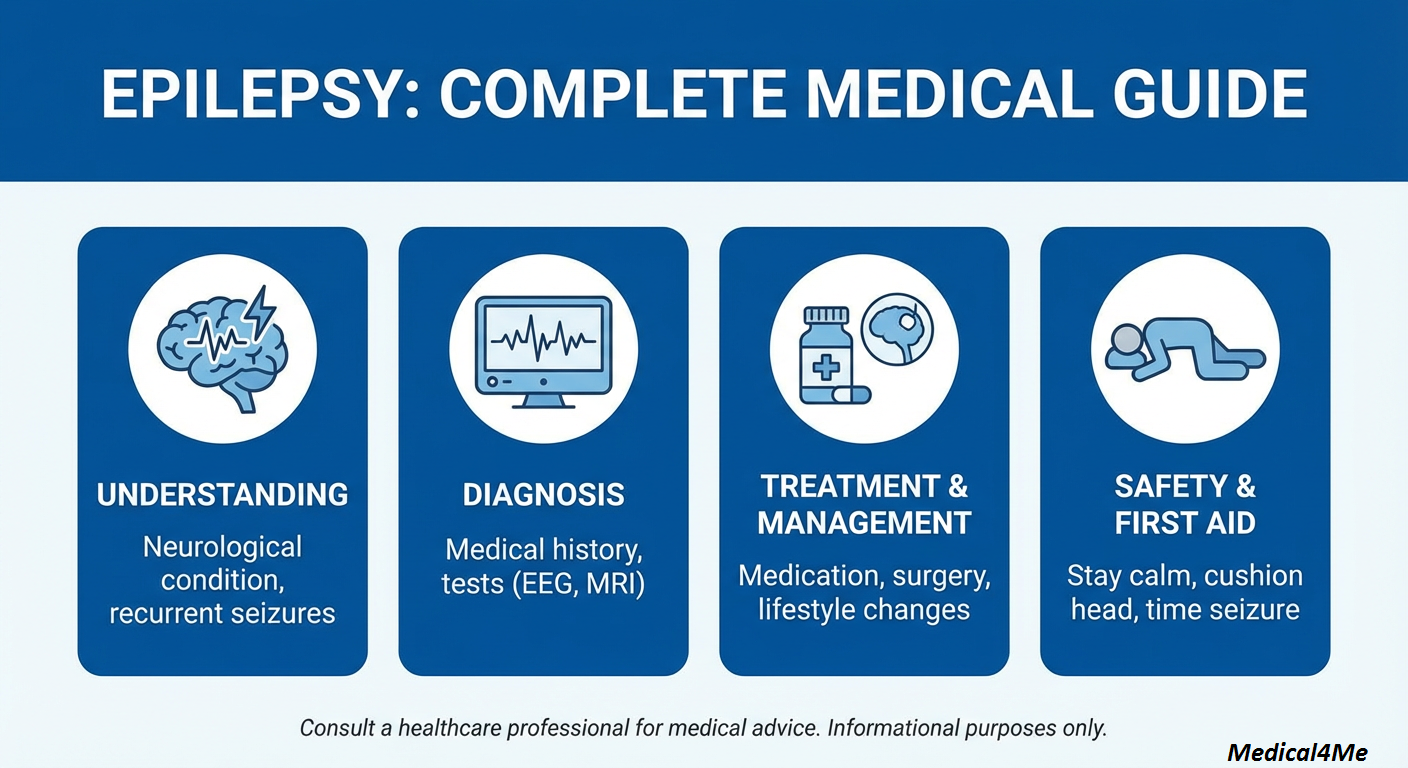
- The History Taking: This is just a chat about what the seizures look like.
- The Neurological Exam: I check reflexes and muscle strength. It is painless.
- Blood Tests: We need to make sure it isn’t low blood sugar mimicking a seizure.
- The EEG (Electroencephalogram): This is the star of the show. We listen to the brain’s electrical activity.
- Imaging (MRI or CT): We take a picture of the brain to look for scar tissue.
Sarah’s MRI was clear. Her EEG showed the “sparks.” We had a diagnosis, and surprisingly, she smiled. Knowing the name of the beast is the first step to taming it.
Treatment Reality
This is where things get hopeful. For about 70% of people, seizures can be completely controlled with medication.
We have come a long way from the old days. Modern medicine is precise. While I always suggest checking resources like Medical4Me for broader health tips, let’s look at specific Epilepsy drugs.
Two Common Medications
- Levetiracetam (Keppra):
- How it works: It stops the release of chemicals that trigger the electrical “storm.”
- Side Effects: It can sometimes make people feel irritable, though this doesn’t happen to everyone.
- Lamotrigine (Lamictal):
- How it works: It stabilizes the electrical gates in the brain cells so they don’t fire too easily.
- Side Effects: We watch for a rash, but otherwise, it is very well tolerated.
Medical vs. Surgical Options
Sometimes, medicine isn’t enough. Here is a comparison I often draw up for patients considering their options:
| Feature | Medication (AEDs) | Surgery / VNS Therapy |
|---|---|---|
| Invasiveness | Non-invasive (pills) | Invasive (requires procedure) |
| Success Rate | Works for ~70% of patients | Used when meds fail; variable success |
| Recovery Time | None (immediate start) | Weeks to months depending on type |
| Permanence | Must take daily, forever | Can offer a permanent fix |
| Cost | Ongoing monthly cost | High upfront cost |
Let me tell you about Mateo. He was a 16-year-old soccer player. His parents were terrified to let him play. “What if he falls? What if he gets hit?”
We started him on Lamotrigine. We had a long talk about lifestyle—specifically getting enough sleep and staying hydrated. Mateo hasn’t had a seizure in three years. He is captain of his college team now. That is the goal. Not just to survive, but to live.

Epilepsy Red Flags
Most seizures stop on their own. It is terrifying to watch, I know. You feel helpless. However, usually, the brain resets itself within a minute or two.
But, as the CDC guidelines state, there are specific times you must call for help immediately:
- The seizure lasts longer than 5 minutes.
- Another seizure starts immediately after the first one stops.
- The person cannot breathe or wake up after the shaking stops.
- The seizure happens in water.
- The person is pregnant or has diabetes, like with other conditions.
Frequently Asked Questions My Patients Ask
Yes, usually. However, they must be seizure-free for a specific period (often 6 months to a year) determined by local laws.
Actually, no. Photosensitive epilepsy is rare, affecting only about 3% of people with the condition.
Absolutely not. That is a myth. Therefore, never put anything in their mouth; you might break their teeth or cause injury.
For some children, they outgrow it. For adults, it is usually “managed” rather than cured, but management can mean zero seizures.
Yes. Specifically, stress, lack of sleep, and alcohol are the three biggest triggers I see in my practice.
My Final Professional Advice
If I could reach through this screen and hold your hand, I would tell you this: Epilepsy is a diagnosis, not a life sentence.
I have treated lawyers, pilots, teachers, and parents who have this condition. They have families. They travel. They laugh.
Do not let the fear of the “next one” rob you of the joy of right now. Trust your medical team, be consistent with the medication, and give yourself grace. You are stronger than you think, and so is the person you are worried about.
Now, try to get some sleep. Everything looks a little more manageable in the morning light.

Medically Reviewed By
Dr. Saqlain Mushtaq, MBBS
Lead Medical Author, Medical4Me.com
About Our Editorial Process
💬 Share Your Experience
Share your thoughts, questions, or personal tips below. Our community and editorial team value respectful and insightful discussions.