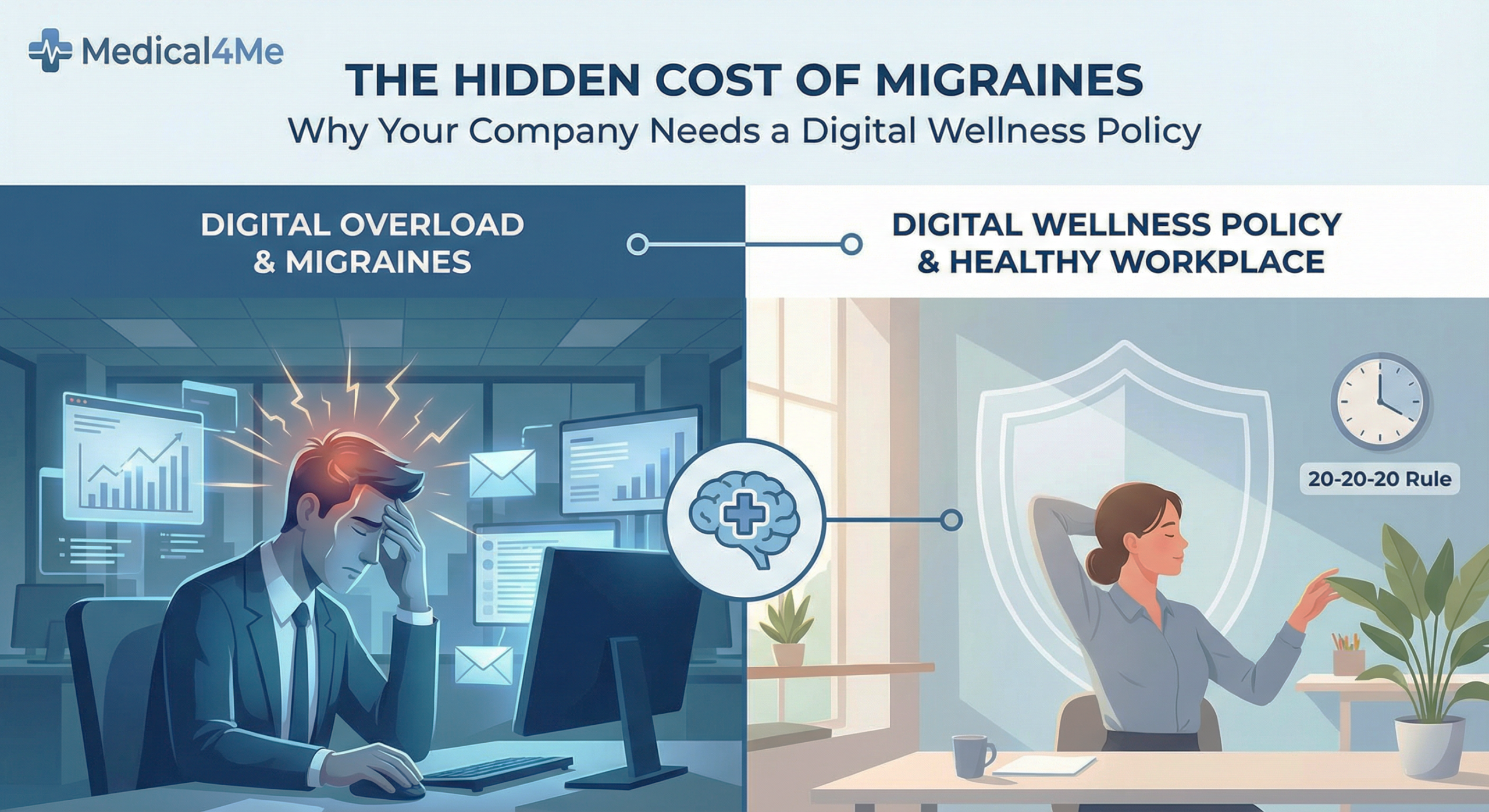
The Hidden Cost of Migraines: Why Your Company Needs a Digital Wellness Policy
Being a chronic migraine patient and having to juggle the requirements of a busy work-related life in a company is a draining nonverbal struggle. Millions of hard working personnel are before the blinking screens each and every day silently swearing themselves to death just so that they can get their deadlines met. I hear the agonies of such people in my clinic regularly as a medical practitioner. It is the constant need to stay digitally connected and are silently breaking down our natural biological defenses.
We should also deal with the fact of how our workplaces are bad to our health. The full-scale solution is transformation using pain medication but without alteration of the corporate culture. Today, we are going to examine the deep physical effect of digital over-load, the use of biological Warning Signs, and why adoption of a corporate policy concerning digital wellness is a medical necessity.

Concepts of the Neurological Effect of Screen Time:
he brain is a wonderful-developed organ but it was not actually made to think long streams of not natural light and computer-generated information up to as much as eight or ten hours at a time. In time, and when you sit and stare at a screen without a break, your optic nerve and centres of sensory processing is tricked out.
Imagine your nervous system as that of an electrical panel in a big office building. In a normal situation, power is flowing in a normal manner. Nevertheless, when all the individual rooms are connected with equipment with high-wattage, the system undergoes a colossal burst. To avoid an outbreak fire, the key breaker trips and therefore the power is cut completely. The same is the case with a migraine. It is a convulsed, intensely protective brain disconnection, which is provoked by the overload of sensations, which is too detrimental to remain.
Although the medical fraternity still works to research the very particular cellular sparks that trigger such attacks we know about the physical cascade. It is called cortical spreading depression and entails a wave of abnormal electrical activity taking place over the surface of the brain. We are also aware of what causes the same in our contemporary age. In reality, The WHO Stastics indicate that amongst the most common nervous system disorders in the world, headaches disorders are highly fomented by our cyber lifestyles.
Recognizing the Biological Warning Signs
I would like to tell you about Zanish. She is a senior data analyst in the large technology company where she works remotely. She has to work with huge spreadsheets on multiple monitors as used in her job. My client has recently presented herself to my clinic saying that she started experiencing fearful visual disturbances. A few seconds before a crippling headache would begin, she would see jagged and sparkling lines that totally blocked her vision and then a frightening numbery feeling in her fingers. She was very excited to know that she was not having one, but a classic visual auras as a result of intense eye strain of the digital kind.
As a patient complains of such symptoms, I have to first audit the daily digital habits of the patient. The symptoms of this particular form of neurological overload are usually swept away as mere fatigue yet they are very specific warning medical bells.
You should never ignore these undeniable symptoms:
- Intense, rhythmic throbbing pain that anchors itself fiercely behind one eye or on one side of your head.
- Profound sensitivity to light (photophobia), making the blue glare of your laptop screen feel physically painful.
- Severe nausea, which often makes sitting upright at a desk feel entirely impossible.
- Visual auras, including shimmering blind spots, flashing lights, or geometric patterns drifting across your field of vision.
- A heavy cognitive fog that leaves you completely unable to focus on professional tasks.
The Root Causes of Workplace Migraines
The background of such attacks is entrenched in the current business demands. The employees are supposed to be fully available always and always on the move. This is of course, an unnatural condition with dire physical effects.
The blue light that is produced by our devices has penetrated deep into the retinas. The wavelength of light has the aggressive effect of disrupting your sleep cycle by killing the natural melatonin production of the body. Moreover, bad sitting position makes the muscles of the neck stiff and prevents the flow of oxygenated blood flow to the brain. This leaves your nervous system in a constantly, in low grade, state of stress. Due to these unique hazards at the workplace, CDC guidelines state protocols explain that environmental triggers management is an entirely crucial procedure towards restoring your well-being.
The Diagnostic and Evaluation Process
Take the example of Tahir, a software engineer based in the distant part of a company, who is brilliant. He experienced loss of the power to articulate himself properly in the course of major video calls, which were then succeeded by crippling headache. He was completely stressed and apprehensive of his career. We sat and discussed his horrifying mystery to make it a reasonable, working medical proposal.
Should you come to a clinic on these symptoms, a doctor will approach you in the following way:
- The Clinical Interview: We begin with a detailed discussion of what the exact nature of your pain is, how many hours you work daily and the antecedents preceding the onset of an attack.
- The Trigger Journal: You will be requested to regularly monitor your screen time, meeting schedules and pain rates in a couple of weeks to discover the irrefutable correlations.
- The Neurological Examination: Reflexes, muscle strength, and visual tracking will also be done by a doctor who will be assured to rule out other underlying neurological problems.
- The Environmental Audit: We are talking about the expectations of your employer so that we can identify the possible ways of the risk to be modified by communicating with the employer about screen breaks and after-hours communication.
- The Official Diagnosis: According to the obtained information, there is an officially established idea about your situation, which will enable us to develop an extremely specific treatment regimen.
Actionable Solutions and Treatment Options
The lives of enduring severe pain and working a successful career are not something that one has to accept. The methods of safeguarding your neurology are highly efficient, just as in case with other conditions that we cure on a daily basis.
The adoption of Lifestyle and Corporate Protections:
This is precisely the reason that your business is direly seeking an online wellness policy. With a physically toxic work environment one can not medicate his or her way out. There should be no tolerance of boundaries of a good wellness policy. This involves the introduction of 20-20-20 rule to the company: Every twenty minutes each one should observe something that is twenty feet away and hold on to it twenty seconds
Also, employers must install blue light filtering software at enterprise wide level on all the devices provided to the employees, and create a communication boundary where internal emails create no emergencies should not be dispatched after working hours. By making such structural divisions a highly taxed nervous system gets the space it badly needs to bounce back. Avoidance of the lifestyle changes is the most important tool in my arsenal, and it is the idea that I discuss most of the time within my recent posts.
Medical Interventions
There are occasions when we apply our utmost efforts with digital boundaries and still, some corporations can get through and activate the cycle of pain. This is where specialized medical assistance is needed in that you can stand a chance in supporting your brain.
There is a Danial, a project manager dealing with international logistics. His migraines due to stress were chronic even with wearing blue light glasses and taking serious breaks and even risked him to stop working. We were required to put on medication. According to the treatment of Mayo Clinic explains, the medical way can be broadly split into two strategies, which are either abortive drugs to eliminate present pain, or prophylactic drugs to eliminate future attacks.
To prevent an on-going attack, Tryptan, including Sumatriptan is frequently prescribed to the doctors. This drug is an excellent one because it is an activator of serotonin receptors in the human brain, which causes the painfully swollen blood vessels to narrow softly and in effect blocks the pain channels. One of its most frequent adverse effects is a temporary sense of chest heaviness/tightness which is not harmful but should be observed.
On the other hand, when there are repeated attacks in a week, we use other prophylactic drugs such as Propranol on a daily basis. It was originally deemed as a blood pressure drug, however, it is a beta-blocker that decreases the responsiveness of your blood vessels, and decreases the response of the nervous system to stress. Though extremely useful, it at times may result in fatigue or coldness.
| Treatment Type | Acute Relief (e.g., Sumatriptan) | Daily Prevention (e.g., Propranolol) |
|---|---|---|
| Primary Medical Goal | To entirely abort an attack that is currently happening. | To drastically reduce the frequency of future attacks. |
| Usage Timing | Taken immediately at the very first sign of pain or an aura. | Taken every single day, completely regardless of current pain levels. |
| Major Advantages | Acts incredibly fast; can often restore your ability to function within hours. | Can transform your life by cutting down severe pain days significantly. |
| Potential Side Effects | Can cause a startling sensation of chest tightness; strict monthly limits apply. | Requires a daily routine commitment; can cause persistent lethargy or low blood pressure. |

Critical Warning Sign for Immediate Care
Even though I can give you clear and reassuring instructions, what is more important to you is your physical safety. Most of the time, the pain is manageable, and it even serves as an omen of something that creates an urgent need and must be addressed in case of an emergency.
Emergency Room: Consult an emergency room in case you ever have the following:
- A tremendously intense headache rises in intensity within seconds (so-called thunderclap headache).
- A sudden onset of high fever, excruciatingly stiff neck or deep confusion.
- Pain can occur immediately after any form of physical injury or a fall.
- There are totally new frightening, neurological impairments, the sudden inability to move one half of your body or a severe buzz of your voice.
Frequently Asked Questions My Patients Ask
Yes. The intense visual focus combined with harsh artificial blue light profoundly strains the optic nerve, directly sparking a neurological reaction in susceptible individuals.
It can do both. A small amount of caffeine can help abortive medications work faster, but sudden caffeine withdrawal from skipping your usual office coffee is a highly common trigger.
Frame the conversation around concrete productivity metrics. Show management that reduced digital eye strain directly correlates to fewer missed deadlines and significantly lower employee absenteeism.
No, you are not causing structural brain damage. However, you are severely prolonging your current suffering and making the attack much harder to stop by continuing to strain your nervous system.
No. Taking basic painkillers too frequently causes a phenomenon known as medication-overuse or “rebound” headaches, which ultimately traps you in an endless cycle of daily pain.

Medically Reviewed By
Dr. Saqlain Mushtaq, MBBS
Lead Medical Author, Medical4Me.com
About Our Editorial Process